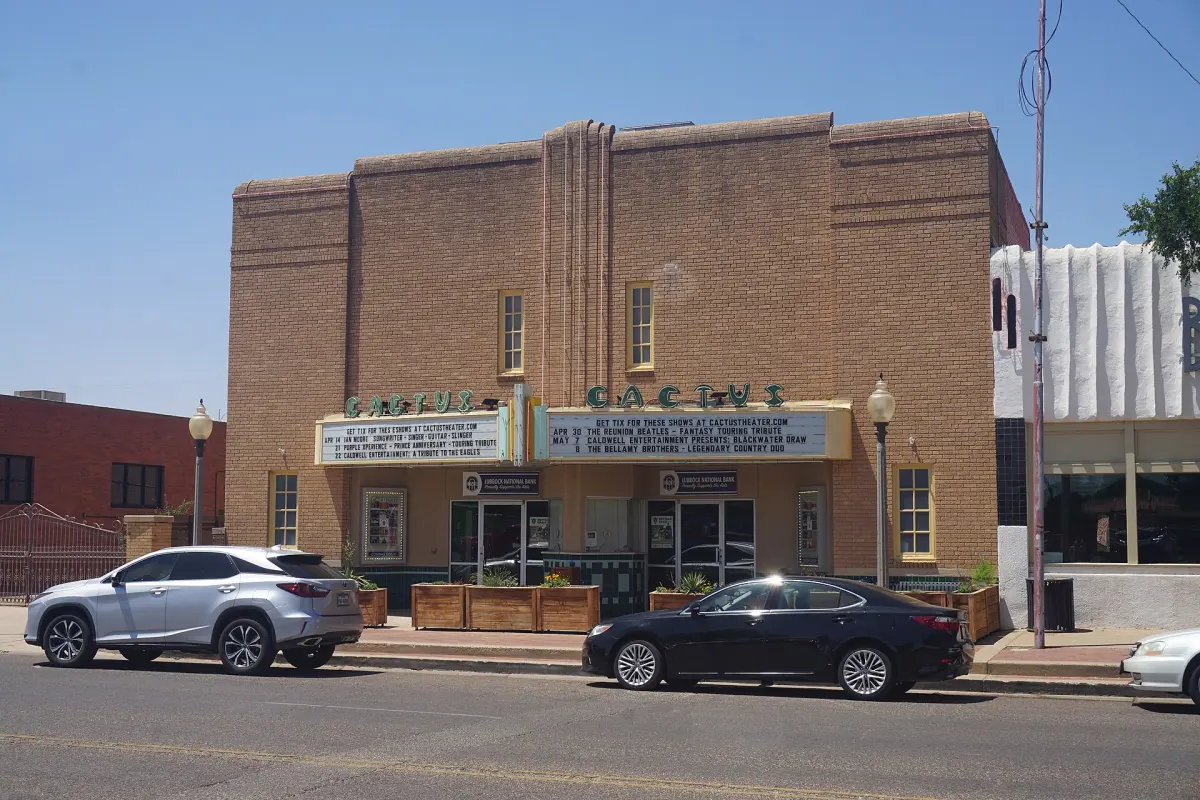
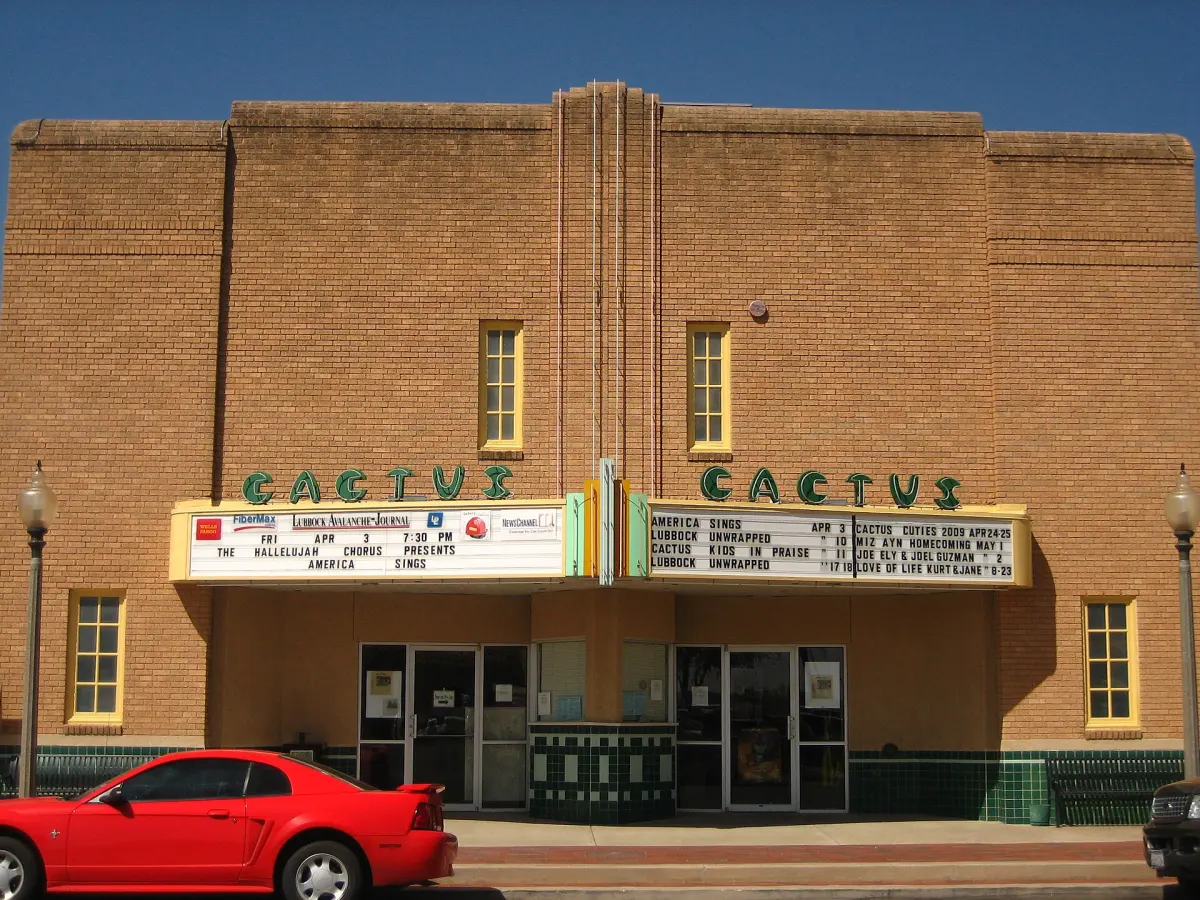
The Cactus Theater opened in April 1938 in Lubbock's depot district, southeast of the downtown business district. Three young businessmen, Joe H. Bryant, M.A. Sanders and Glenn Woody, had pooled their money in December 1937 to build the city's first theater outside the central business district, and financier A.M. Leftwich supplied more capital. Local builder Robert Maxey put up the two-story concrete building for $30,000; its National Register nomination notes that the designer is unknown. Inside were 720 narrow seats, a small stage, a balcony and "washed air cooling."
The owners billed the Cactus as "the family theater." It opened with Wings over Honolulu, starring Wendy Barrie and Ray Milland, and charged 10 cents for children and 20 cents for adults, when first-run houses downtown charged 25 and 75 cents. It stayed a bargain second-run house, drawing customers from a growing residential area and students from Texas Technological College; over twenty years adult admission rose only to 30 cents.
Lubbock had 16 theaters by 1950, but television and six new drive-ins thinned their crowds. On May 6, 1958, the Cactus ran a double feature, Shoot Out at Medicine Bend and Fuzzy Pink Nightgown, and never reopened. Its seats and projectors were stripped out, and for years the neighboring Greer Iron Works used it for storage.
In 1993 Lubbock music producer Don Caldwell and a group of investors formed Cactus Theater, Inc., and bought the building. They kept the balcony, sloped floor and stage, rebuilt the ticket booth and neon marquee from historic photographs, put in about 400 wider seats, and had artist John Russell Thomasson paint Caprock Canyon murals around the auditorium. The Cactus reopened in 1995 for live music, plays and classic films, helping turn the old warehouse blocks into the Depot Entertainment District. In 1996 the city renamed its stretch of Avenue H as Buddy Holly Avenue, after the Lubbock musician. The Cactus was listed on the National Register on May 8, 1998; by then it was the only one of Lubbock's seven 1938 theaters still standing intact.
Music promoter Darryl Holland bought the theater on July 1, 2016. The theater has since installed a digital projection system and a new sound system, and it now runs a film calendar alongside its concerts.