Texas Call Sheet Post a call
Forest Theatre
Texas film legacyneighborhood theater

Forest Theatre

Interstate built it for white audiences, then on March 2, 1956, reopened it for Black patrons only; news reports at the time said it was likely the largest Black theater in the southern United States.

Dallas · Opened 1949 · Closed 1965 · closed as a movie theater 1965; vacant since 2009; owner CitySquare planning a…
1904 Martin Luther King Jr. Blvd., Dallas, TX 75215

The story

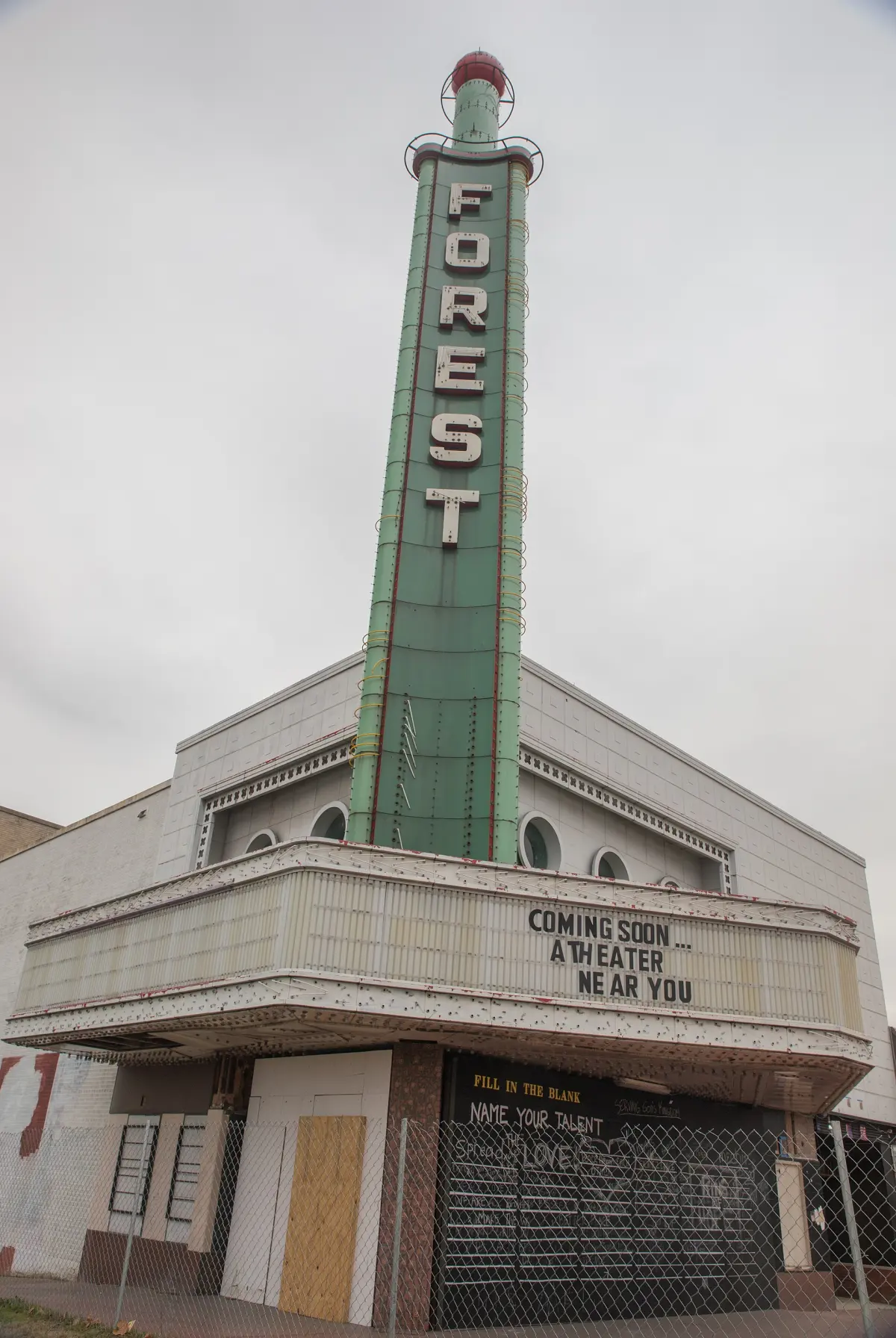
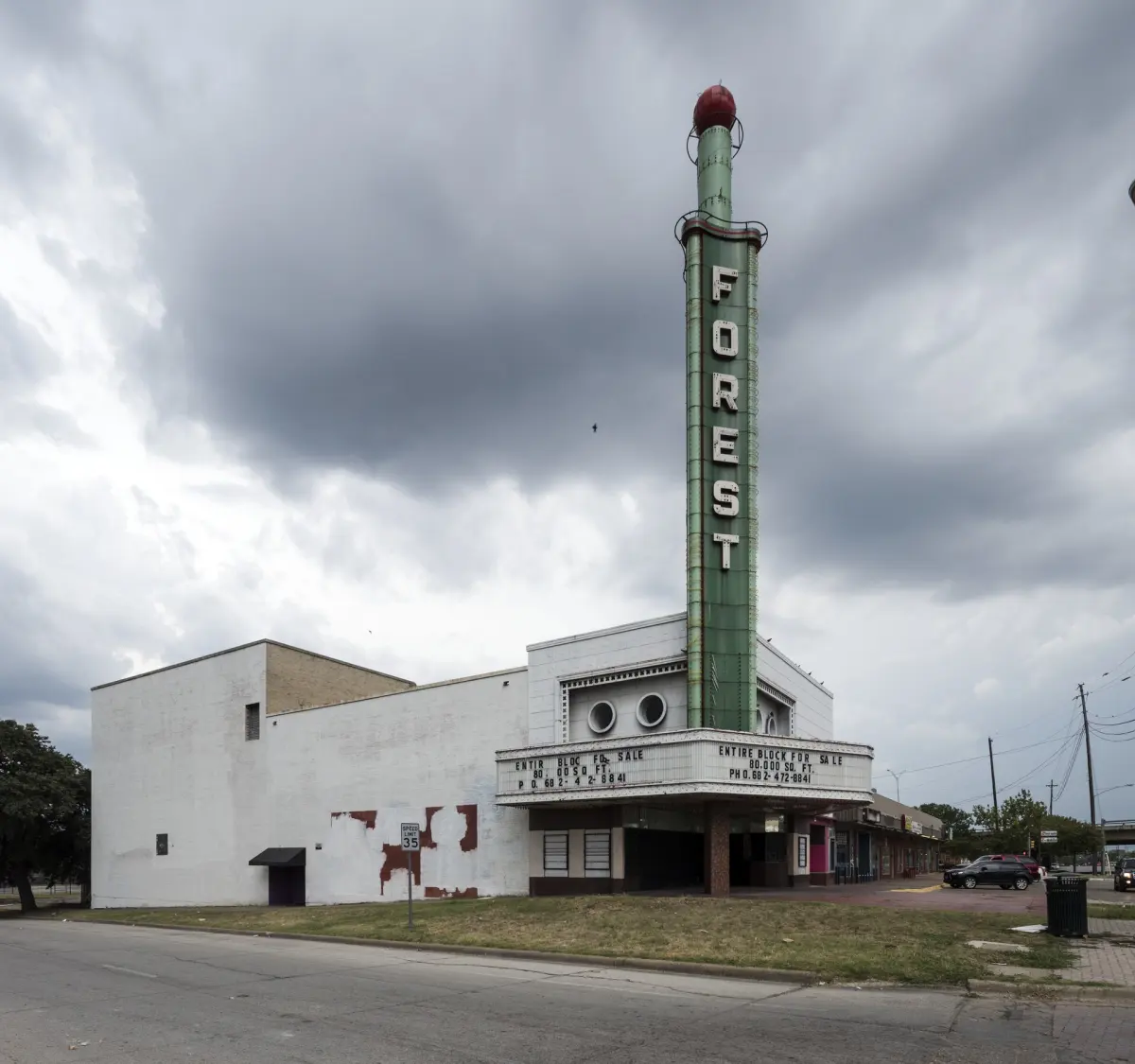
Interstate Theater Circuit built the Forest Theatre in 1949 to replace its smaller 1914 Forest Theatre in South Dallas, building the new house just east of the old one. Pettigrew-Worley & Co. designed the Streamline Moderne building on Forest Avenue, now Martin Luther King Jr. Boulevard, beside the new Central Expressway. It had a three-sided neon tower, a porcelain-enameled steel front, a sweeping lobby ramp and a two-story mural of tropical plants and birds by Eugene Gilboe. With 1,480 seats and a row of shops, it cost more than $300,000 and was Interstate's largest theater. More than 5,000 people jammed the opening on July 29, 1949, for It Happens Every Spring.

The Forest was built for white audiences only. As Black families moved into the surrounding neighborhoods and white residents left, business fell. On February 21, 1956, Interstate closed the theater to white customers, and on March 2 it reopened for Black patrons with spotlights, speeches, the Booker T. Washington High School band and a double feature of Helen of Troy and The Nat King Cole Story. Reports called it likely the largest Black theater in the southern United States. It mostly showed second-run films, and by late 1958 it was open only on weekends.

When activists protested segregated Dallas theaters in 1960 and 1961, Interstate answered that Black moviegoers had the Majestic's balcony and the whole Forest; demonstrators replied that the Forest was out of the way and showed second-run pictures. Dallas theaters were integrated in mid-1963, and Interstate stopped showing movies at the Forest in September 1965.

In 1967 the building became the Central Forest Club, where Rubin Willis booked Marvin Gaye, Aretha Franklin and B. B. King, and later hosted acts from Ike and Tina Turner to Prince. After the auditorium was divided in 1976, part of it appears to have run as a cinema showing blaxploitation films in 1978. Erykah Badu leased the theater from 2003 to 2009 and ran it as the Black Forest Theatre, with concerts, community events and film screenings. Vacant since 2009, it was bought in 2017 by the nonprofit CitySquare, which planned to rehabilitate it as a community arts and training center. It was listed in the National Register of Historic Places on December 4, 2019.
Why it matters

At 1,480 seats and more than $300,000 with its commercial block, it was Interstate's largest theater when completed. ↗︎
More than 5,000 people jammed its July 29, 1949, opening, which showed It Happens Every Spring. ↗︎
During 1960–1961 theater protests, Interstate pointed to the Forest and the Majestic's balcony as its provision for Black moviegoers; demonstrators answered that the Forest was out of the way and showed mostly second-run films. ↗︎
Producer Jim Beck's recording studio occupied one of its storefronts from 1953 to 1956. ↗︎
Erykah Badu leased it from 2003 to 2009 and ran the auditorium as the Black Forest Theatre for concerts, community events and film screenings. ↗︎

Owners

OwnerYears
Interstate Theater Circuit (built and operated it; white patrons only to 1956, Black patrons only from 1956)1949–1965 ↗︎
Rubin Willis (Central Forest Club)1967–1971 ↗︎
Albert H. Reynolds / Meadowbrook Corporation of San Antonio1979–late 1990s ↗︎
Julinmar Investments, Inc.late 1990s–2017 ↗︎
Erykah Badu (lessee, as the Black Forest Theatre)2003–2009 ↗︎
CitySquare (nonprofit)2017– ↗︎
Preservation
National Register of Historic Places ↗︎
Streamline Moderne design by Pettigrew-Worley & Co., built by O'Rourke Construction, with a sculptural marquee, three-sided beacon tower, porcelain-enameled steel facade and neon. ↗︎
Interiors under Eugene Gilboe included a two-story lobby mural of tropical plants and birds and a sweeping ramp to the mezzanine; it opened with push-back seats, air conditioning and a cry room. ↗︎

Photos

Forest Theatre
Forest Theatre
Sources
  1. National Register of Historic Places Registration Form: Forest Theatre, Dallas, Dallas County, Texas Texas Historical Commission / National Park Service 2019-02-19
  2. Forest Theatre (National Register listing) Texas Historical Commission Atlas 2019-12-04
  3. Forest Theatre Cinema Treasures
Image credits (2)

Forest Theatre: Renelibrary, CC BY-SA 4.0, Wikimedia Commons; Forest Theatre: Carol M. Highsmith, Public domain, Wikimedia Commons.

Correct this page