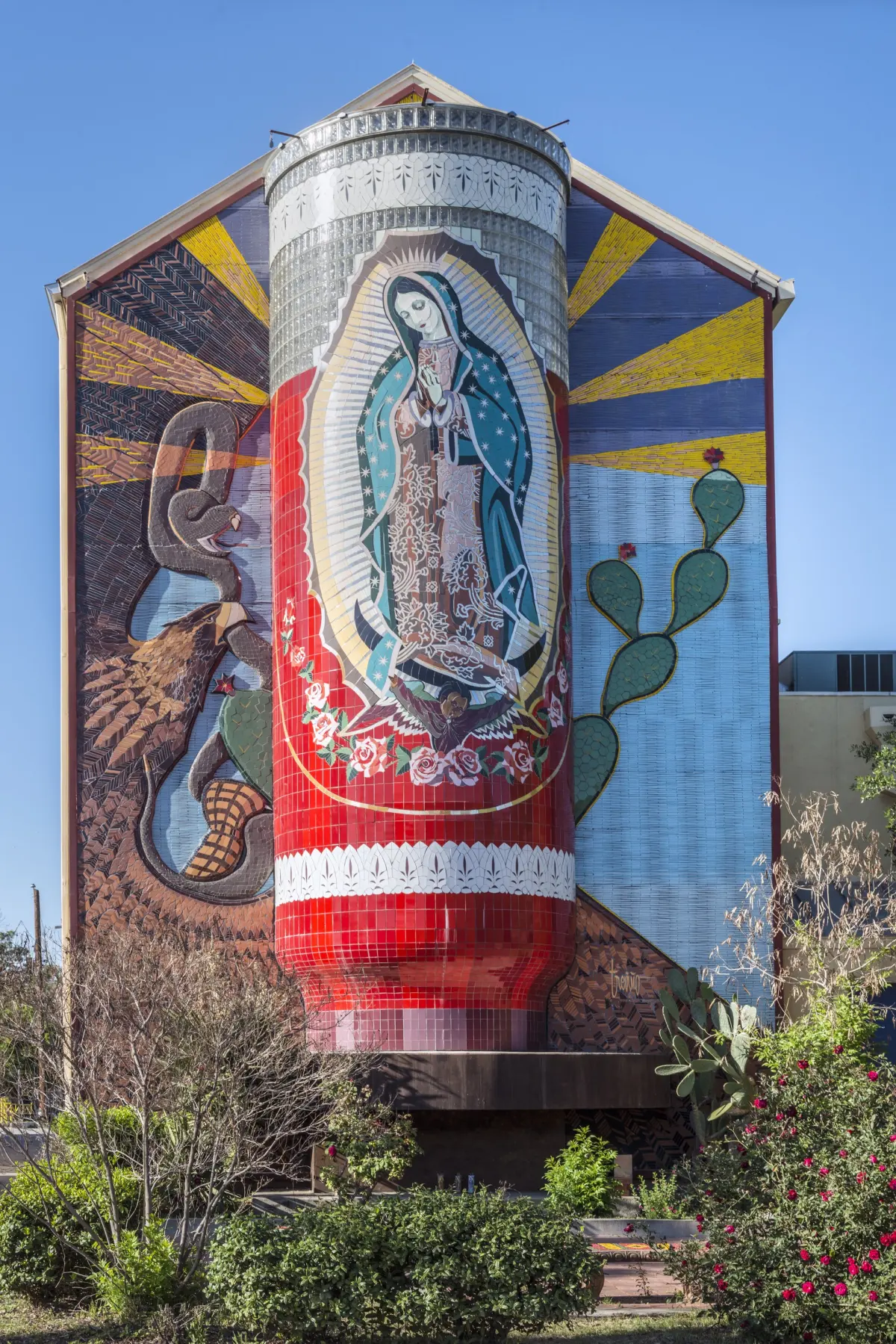
Teatro Guadalupe stood on Guadalupe Street in the heart of San Antonio's West Side. The Handbook of Texas calls it the West Side's most opulent movie theater and dates its run from 1940 to 1970. Cinema Treasures gives an opening date of July 3, 1942, when the theater showed the U.S. premiere of the Mexican film Águila roja with a Cantinflas short, and credits the design to N. Straus Nayfach, who later designed the Alameda. Like many single-screen houses it lost its audience in the 1960s. It closed, reopened in early 1972 as the Aztlan Theatre showing American features, closed again in 1973 and later held a flea market.
Its second life came from Chicano artists. In 1979 several Hispanic arts groups formed the Performance Artists Nucleus, or PAN, and in the early 1980s leaders including Rolando Rios and Ralph Garcia decided they needed a permanent home near the community they served. Councilman Bernardo Eureste persuaded the city to buy the land under the old theater, and developer William Schlansker raised $1 million to rebuild it from plans by the Reyna–Caragonne firm. PAN renamed itself the Guadalupe Cultural Arts Center, and the reconstructed 400-seat theater, equipped for both stage and screen, opened in the spring of 1984.
The theater is the center of a campus that by 2018 included six buildings. Its cinema program shows Spanish-language and Latino films, with series from Mexico, Brazil, Spain, Argentina and elsewhere in Latin America. Since 1983 the center has presented CineFestival, which began in 1975 under the sponsorship of Oblate College and which the Handbook calls the country's longest-running Latino film and video festival. Guests over the years have included Edward James Olmos, Guillermo del Toro, Luis Valdez and Gina Rodriguez. Since 2017 the festival has focused on Texas and regional filmmakers, and its 47th edition, held July 9 to 12, 2026, at the Carver Community Cultural Center, screened more than 80 films.