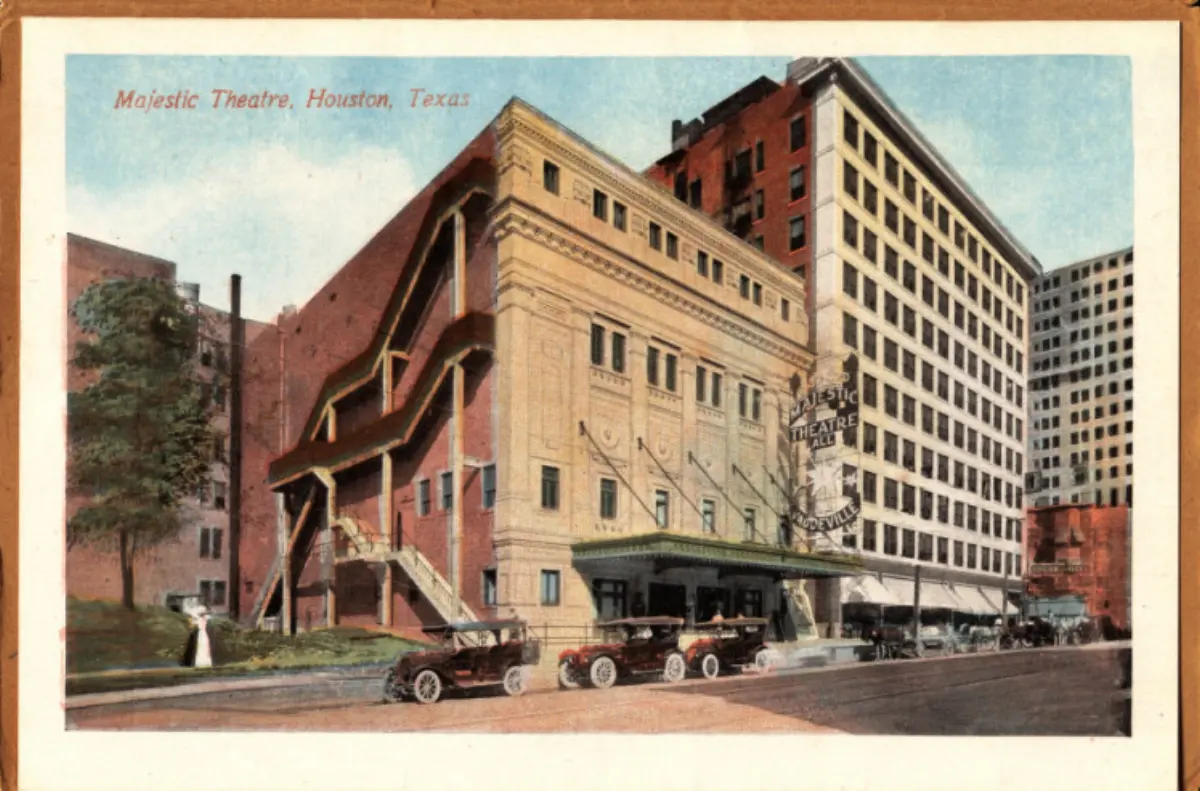
The Majestic on Rusk Street was the first project of Mellie Esperson, whose husband Niels had left her an oil-rich ranch and other business holdings when he died in 1922. She hired Chicago architect John Eberson, and the theater opened on January 29, 1923, with Larry Semon in The Counter Jumper, vaudeville acts, and actor Henry B. Walthall appearing in person. It was the third Houston theater called the Majestic built by Karl Hoblitzelle's Interstate chain; when it opened, his older Majestic was renamed the Palace.
Eberson did not design the Majestic's auditorium as a room. He designed it as an outdoor garden in a faraway place. A Mediterranean-blue ceiling set with twinkling lights stood in for a starlit sky, clouds drifted across it, and the two side walls were given completely different shapes. Cinema Treasures records it as Eberson's first atmospheric theater, and Houston film historian David Welling calls it the world's first atmospheric movie theater and the greatest movie theater ever built in the city. The house sat 2,081, had a Kilgen organ, and was the first theater in Houston with air conditioning.
Cinema Treasures says RKO took it over in May 1930; Welling describes it as Interstate's main Houston showplace through the Depression, and Interstate was running it in the 1940s. Eberson went on to design Esperson's Niels Esperson Building, the 32-story tower on Travis and Rusk that opened in 1927. The theater showed first-run films for its whole life. It closed on September 26, 1971, with Tom Stern in Clay Pigeon and was demolished right away, almost fifty years after it opened. By then the style it introduced had long since spread: Eberson's firm alone designed nearly 100 atmospheric theaters by the end of the 1920s.