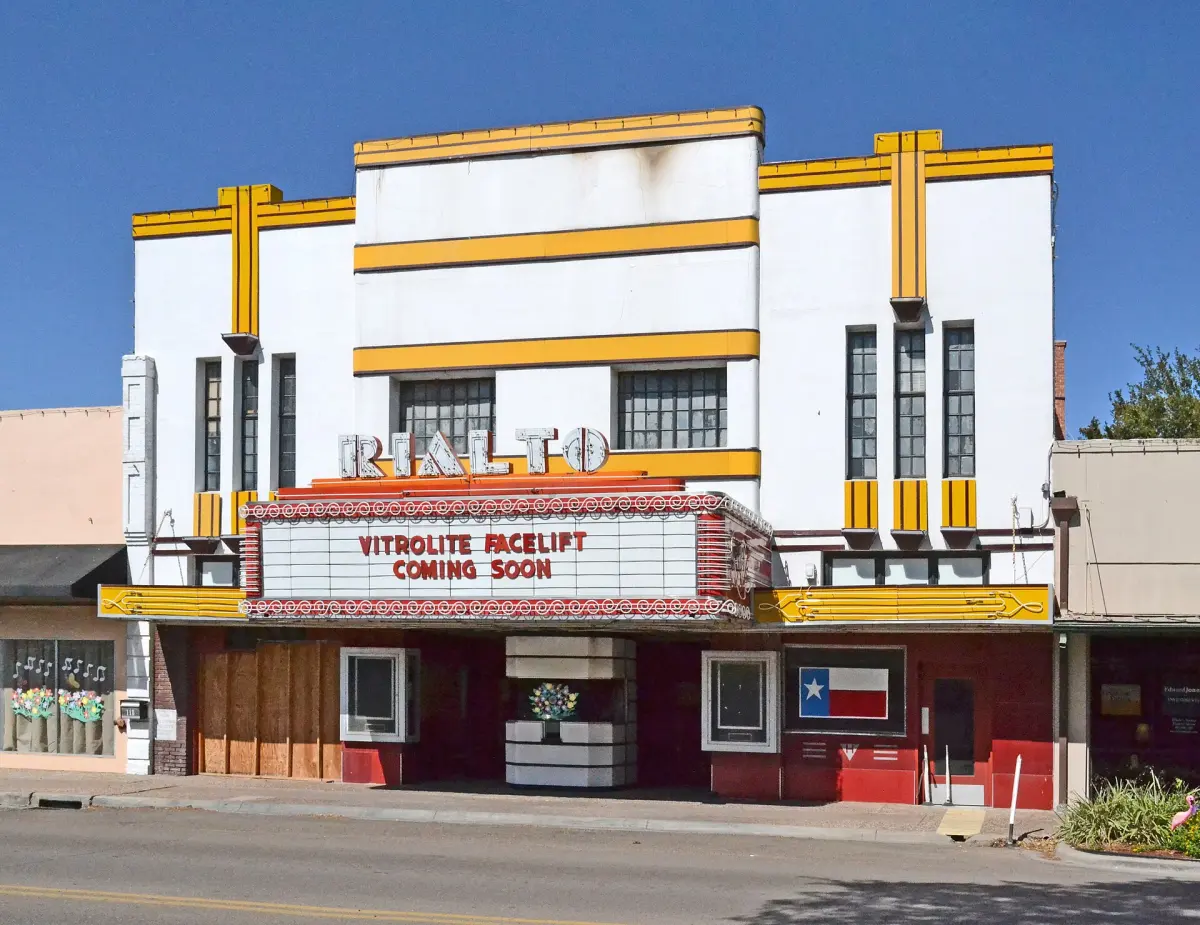
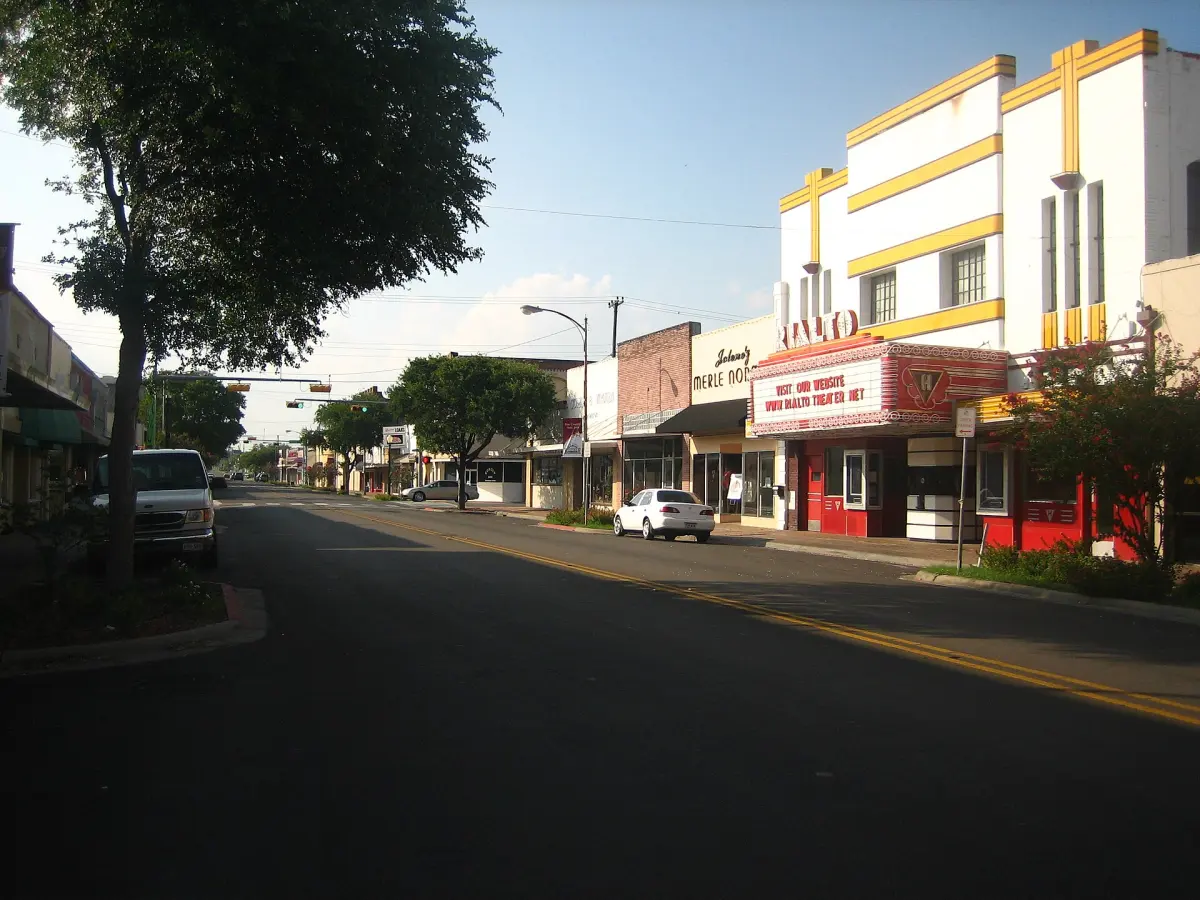
The H.W. Hall family ran a chain of movie theaters across South Texas, and in 1922 they opened the Rialto on Washington Street in Beeville as its flagship. Architect W.C. Stephenson, who had designed the 1912 Bee County courthouse, gave it a red-brick Classical Revival front. It cost $25,000 and had opera chairs, chandeliers, a telephone-equipped ticket booth and a typhoon cooling system that its National Register nomination calls the first of its kind in South Texas. The stage could take vaudeville and road shows. The theater was segregated: an August 1922 report in the Bee-Picayune said half the balcony would be "for colored patrons and half for Mexicans," with the whole main floor reserved for whites. In December 1924 the Hall brothers put Beeville's first radio station, KERB, on the Rialto's roof, and in 1929 they added Western Electric sound.
On December 3, 1935, a spark from a workman's torch smoldered under the stage and grew into a fire that destroyed the screen, the sound horns, nearly all the seats and the auditorium's decoration. While the Halls rushed a commercial building into service as the Rio Theater, they hired the Chicago firm of John Eberson, known for atmospheric movie palaces and in Texas for Interstate's Paramount in Austin and the Majestics in San Antonio and Dallas. The Rialto reopened on March 5, 1936, with The Trail of the Lonesome Pine. It now had an Art Moderne front of red porcelain enamel and neon, an Art Deco interior trimmed in gold leaf, a Carrier refrigeration unit that the nomination says no other theater between San Antonio and Corpus Christi had, and headphones for hearing-impaired patrons.
The Rialto drew audiences from the surrounding towns for first-run movies and stage shows, and John Wayne, Jeff Chandler, Greer Garson and Jimmy Stewart appeared there for war bond drives during World War II. Enforced seating segregation broke down during the war, and by the 1950s the balcony was a hangout for kids.
After about sixty years as a movie house, the Rialto showed its last film in the mid-1980s. The Hall-Rialto Preservation Association bought it from State Bank and Trust in 1991, and it was listed on the National Register on November 21, 2001. Cinema Treasures reports that the association is still raising money to finish the restoration and reopen.