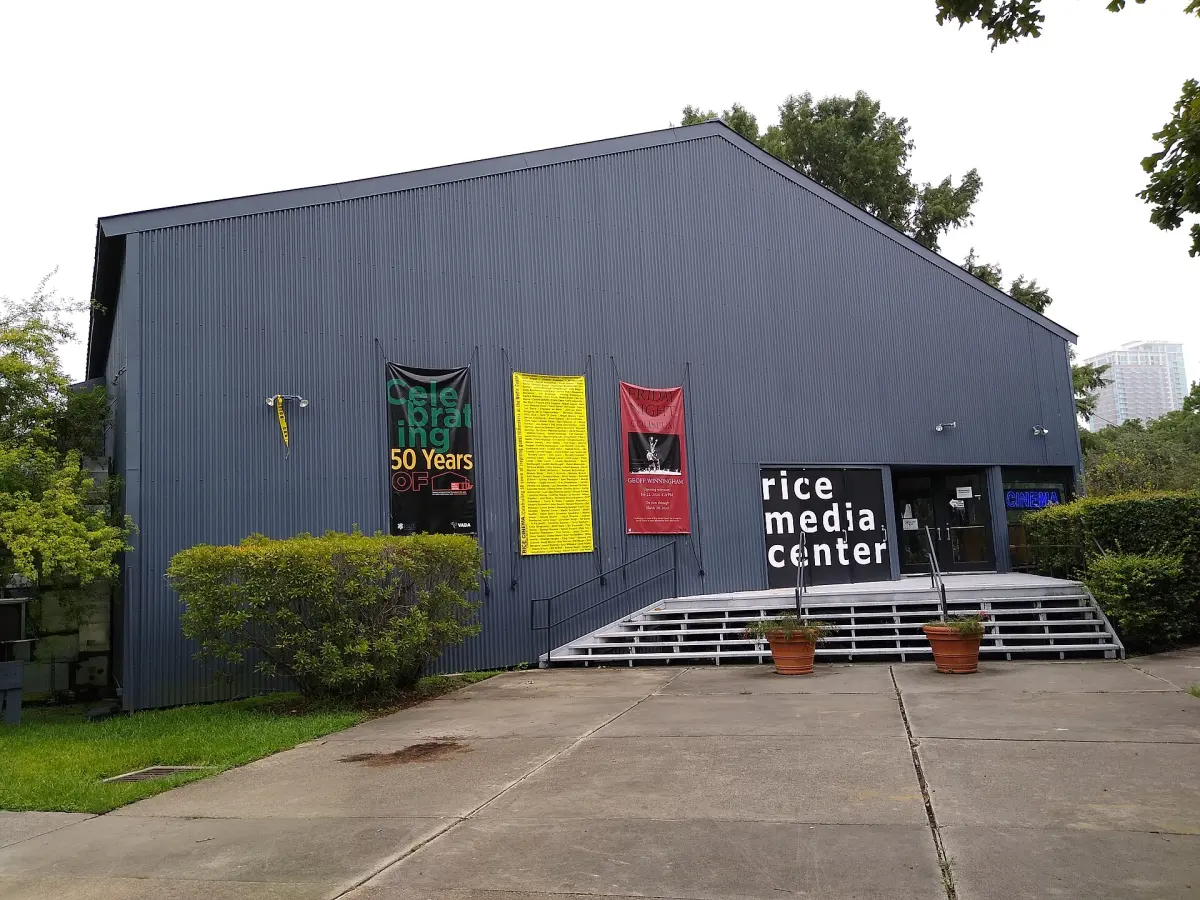
The Rice Media Center grew out of John and Dominique de Menil's move of their art program from the University of St. Thomas to Rice University in the late 1960s. Along with art historians, a library, and an exhibition program, the shift brought a photography and film program with two instructors. Rice had no room for them, so the de Menils put up two temporary buildings of neutral design away from the main campus: one, later called the Barn, for exhibitions and studio space, and next door the Media Center. Rice's history page credits the design to Houston architect Eugene Aubrey of Barnstone and Aubrey.
The de Menils had already hired Gerald O'Grady, a former Rice literature professor, to build awareness of film and media in Houston. O'Grady left to found a media center at the State University of New York at Buffalo, and the Rice center opened under two of his recruits, filmmaker James Blue and photographer Geoff Winningham. To inaugurate it, John de Menil arranged a preview of Andy Warhol's Lonesome Cowboys in the Grand Hall of the Rice Memorial Center, with Warhol and his entourage parading before the audience; the department's founding chair recalled that administrators reacted with dislike and distaste. The Media Center opened officially in February 1970, giving Rice its first photography and film courses and opening screenings, exhibitions, and lectures to the public. Warhol planted a tree with Dominique de Menil outside the Institute for the Arts that year.
Rice describes the program the de Menils set up as a cinematheque, for screening great films and talking about them. Over the next half century it showed documentaries, foreign films, and experimental work, and brought visitors including Roberto Rossellini, Jean-Luc Godard, Sam Peckinpah, D.A. Pennebaker, Stan Brakhage, Spike Lee, Wim Wenders, Dennis Hopper, Shirin Neshat, and Albert Maysles. Rice marked the center's fiftieth anniversary with a screening series in its original building. Rice Cinema has since moved to the ground floor of the new Susan and Fayez Sarofim Hall, where screenings remain free unless noted, and the old Media Center building is used by the Department of Visual and Dramatic Arts.