Texas Call Sheet Post a call
Ridglea Theater
Texas film legacyneighborhood theater

Ridglea Theater

With about 1,500 seats it was Fort Worth's largest suburban movie theater, and the National Register listing calls it the city's largest single-screen suburban theater.

Fort Worth · Opened 1950 · operating (live events and film screenings); restored and reopened in 2012
6025 Camp Bowie Blvd., Fort Worth, TX 76116

The story

The Ridglea Theater opened on December 1, 1950, on Camp Bowie Boulevard in west Fort Worth. Developer A. C. Luther built it as the anchor of Ridglea Village, the shopping center he had been building since the early 1940s, and his organization kept ownership of the building. The Interstate Circuit, Karl Hoblitzelle's chain, ran the theater. Local papers called it Fort Worth's most modern and largest suburban theater. It had about 1,500 push-back seats, a glass-walled cry room for parents with crying babies, and the Ridglea State Bank in the same building, which opened the same day.

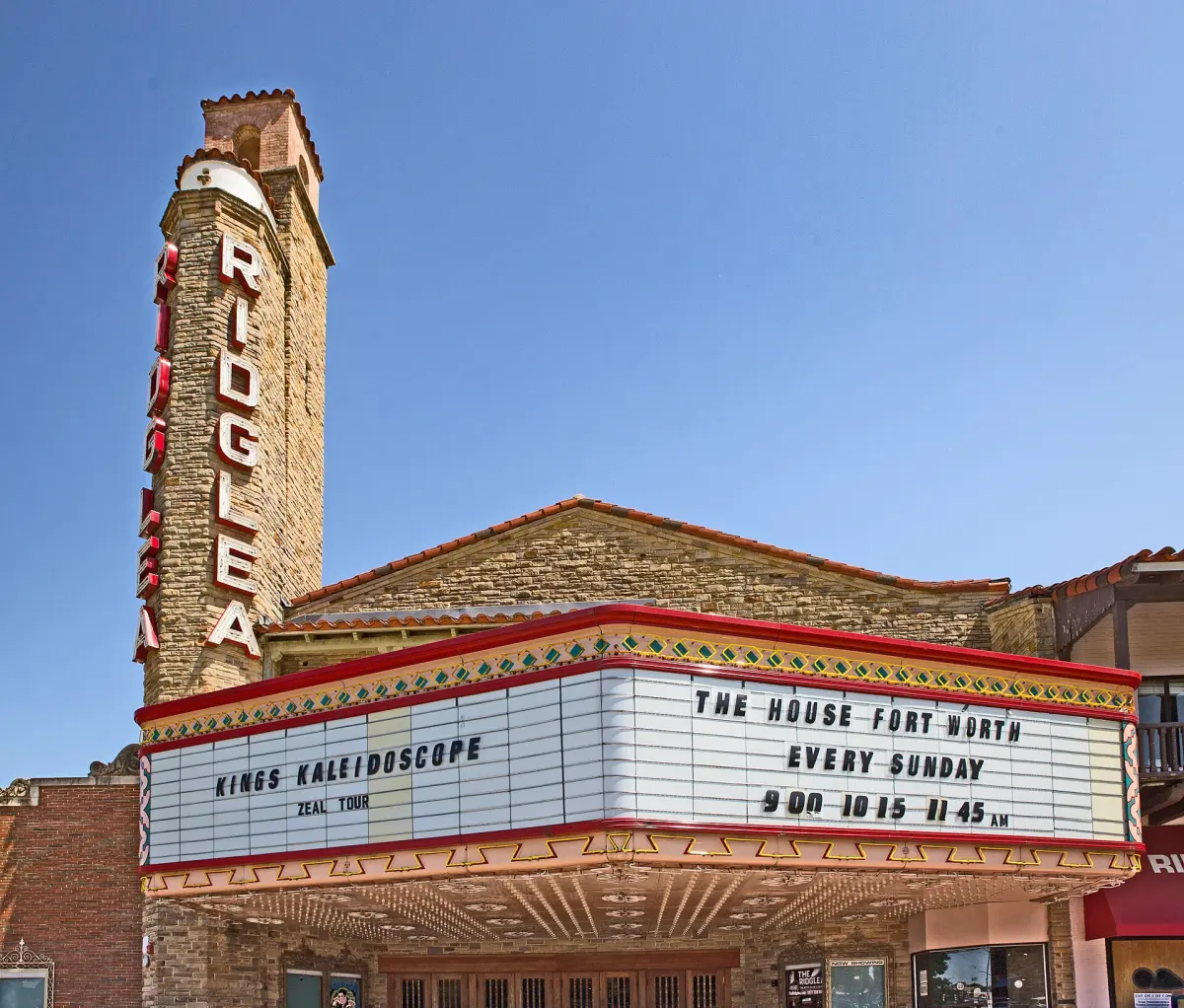
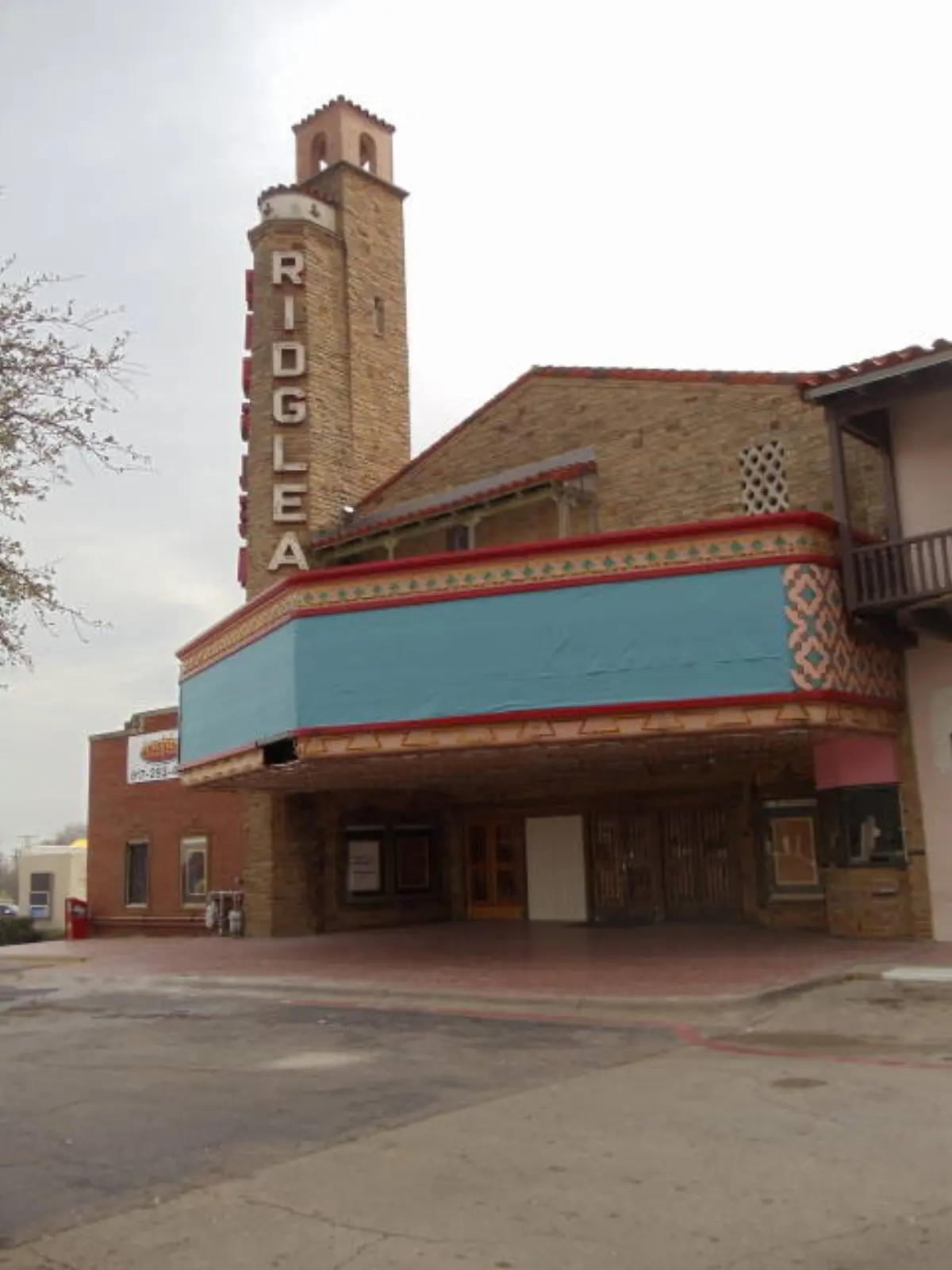
The Dallas firm Pettigrew and Worley, designers of many Interstate theaters, gave it a Spanish Eclectic look to match the rest of Ridglea Village, with a 70-foot stone tower, clay tile roofs and wooden balconies. Interstate decorator Eugene John Gilboe painted lobby murals of Spanish explorers reaching the California coast with pirates in pursuit. The theater admitted white audiences only.

In 1970 Interstate and Texas Consolidated combined as ABC Interstate. Plitt Southern Theatres later owned the theater, and Cinemark took over in 1987, splitting it into three screens. In 1994 it became the Ridglea Movie Grill, with a kitchen and cabaret seating. From 1999 it was mainly a concert hall, booking acts from Leon Russell and Willie Nelson to Death Cab for Cutie while still showing occasional films.

The R. K. Maulsby Family Trust, which owned the building from 1991, put it up for sale in 2008. Fixfunding, LLC of Dallas bought it in 2009, and a plan to raze most of it for a bank branch drew protests from Historic Fort Worth and other preservationists. Jerry Shults bought the theater and bank wing in December 2010 and began a restoration in early 2011. The Fort Worth City Council designated it a Highly Significant Endangered landmark that year, and it was listed in the National Register of Historic Places on December 30, 2011. The restored theater reopened in 2012 with a Retro Ball, with plans for live events and film screenings, and Cinema Treasures lists it as open and showing movies.
Why it matters

It was an Interstate Circuit house; when it opened, Interstate ran 11 other theaters in Fort Worth and its suburbs. ↗︎
The nomination notes the theater was open to white audiences only, with no separate entrance or seating for Black patrons. ↗︎
It played The Empire Strikes Back on the film's initial 1980 release. ↗︎
After Fixfunding, LLC bought it in 2009, fears that it would be razed for a bank drew protests from local preservationists. ↗︎
Bank of America's plan to demolish almost the entire structure for a drive-through branch was opposed by Historic Fort Worth and other preservation groups. ↗︎
It became a concert venue in 1999. ↗︎
Musicians who played there as a concert venue included Leon Russell, Willie Nelson, Bo Diddley and Death Cab for Cutie. ↗︎

Owners

OwnerYears
A. C. Luther (developer of Ridglea Village; his organization kept ownership of the building)1950–unknown ↗︎
Interstate Circuit, Inc. (operator; under United Paramount after the Paramount divestiture, and ABC Interstate from 1970)1950–1970s ↗︎
Plitt Southern Theatres, Inc.after ABC Interstate, to 1987 ↗︎
Cinemark (operator; three screens from 1987, Ridglea Movie Grill from 1994)1987–late 1990s ↗︎
R. K. Maulsby Family Trust (building owner)1991–2009 ↗︎
Fixfunding, LLC of Dallas2009–2010 ↗︎
Jerry ShultsDecember 2010– ↗︎
Preservation
National Register of Historic Places (Ridglea Theatre Building) ↗︎
City of Fort Worth landmark (Highly Significant Endangered) ↗︎
Spanish Eclectic theater-and-bank building by the Dallas firm Pettigrew and Worley, with a 70-foot stone tower, red clay tile roofs and Palo Pinto sandstone. ↗︎
Lobby murals by Norwegian-born decorator Eugene John Gilboe show Spanish explorers landing on the California coast with pirates in pursuit. ↗︎
Opened with 1,500 push-back seats and a glass-walled cry room; the 2011 renovation planned about 650 seats on the main floor and 300 in the balcony. ↗︎

Photos

Ridglea Theater
Ridglea Theater
Image credits (2)

Ridglea Theater: Renelibrary, CC BY-SA 4.0, Wikimedia Commons; Ridglea Theater: Renelibrary, CC BY-SA 3.0, Wikimedia Commons.

Correct this page