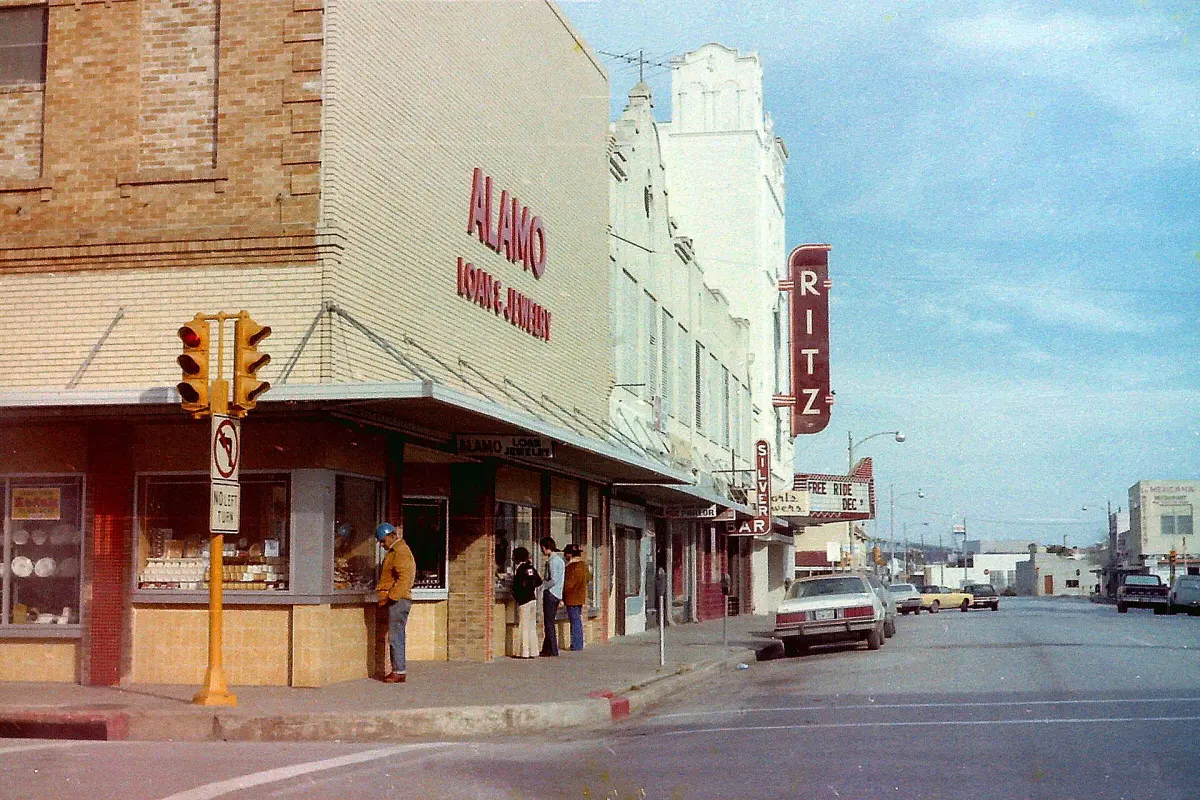
The Ritz Theatre opened on Christmas Day 1929 on North Chaparral Street in downtown Corpus Christi with the talking picture "It's a Great Life." It was built by R. and R. Gulf Amusement, formed in 1925 when local exhibitor H. H. Elliott merged his theaters with the Dallas circuit of Harold Robb and Robert Rowley. By September 1929 the company ran four of the city's six theaters, and it spent about $450,000 on the new house. Adult tickets cost 30 cents, more than at any other theater in town.
Dallas architect William Scott Dunne designed the Ritz as an atmospheric picture palace, with a Spanish Renaissance Revival front and an auditorium dressed as a Spanish courtyard under a painted blue sky. Small lights stood in for stars, and machines on two turrets near the stage sent clouds across the ceiling. The National Register nomination calls it one of the first talking-picture houses in South Texas, and KRIS 6 reports that it also brought air conditioning to local audiences.
The Ritz opened under Jim Crow and at first admitted only white patrons. It had a second entrance and box office on Mesquite Street, and its balcony still separates cushioned seats for white patrons from concrete benches where Black and Hispanic moviegoers sat. The side entrance was enclosed and turned into shops by 1950.
In 1946 the theater closed for a remodel by architect Robert L. Volger that added Art Deco touches, and CinemaScope arrived in 1953. United Artists took over the circuit in 1966. Suburban theaters drew audiences away from downtown, and United Artists ended film showings on August 29, 1972.
The building reopened in 1974 as the Ritz Music Hall, booking Willie Nelson, Bruce Springsteen and the Pointer Sisters, then served mainly as a playhouse until it closed in 1989. The nonprofit Corpus Christi Positive Action Toward Cultural Heritage, or CCPATCH, acquired it in 2010. In 2022 the group accepted a $230,000 Texas Historical Commission grant, paid from National Park Service hurricane-recovery funds, to repair the exterior. The Ritz was listed on the National Register of Historic Places on January 26, 2024. In May 2026 EverGreene Architectural Arts began restoring a test section of the original painted finishes, and the firm says the full restoration is scheduled to finish by the building's centennial in 2029.